My mother is dead, and the culprit is sickness. She lay on her bed as the blood filled her eyes, And I could say nothing but tearful goodbyes Caught fast in my throat, in the paralyzed thickness.
My brother is dead, only sick for a week. While I was out farming, he lay on the ground As buzzards and hawks came to gather around And peck at the nodule exposed on his cheek.
My sister is dead, and I feel nothing more. Her horrible screams were a portent of doom. The agony ripped at the site of her womb Until she was gone, with the pain that she bore.
My cousins and grandparents: all of them passed. Confusion and dizziness kept them awake, And all through the night they would rattle and shake Until they were claimed by the bleeding at last.
My father is dead after days with the illness. His body will lie in the ditch in the village. Abandoned will lie every inch of his tillage, As all that remains is the horrible stillness.
I wonder if there is a place for his soul, Along with the others who prayed with the tongue While never believing a word that was sung, Beside the great god caxtīltēcah extol.
I pray that his world be now better than mine, Deserted and empty of life as it is, But I have been told that the sorrow is his, That illness is punishment from the divine.
So death is the start of the hypocrite’s woes. Rewarded are we who believe in the truth, United in showing contemptible ruth, By watching our families fatten the crows.
Before, we were ten, but alas, we are one, My family gone in the blink of an eye. My village, my people, my friends: oh, but why? What evil in worshiping have they all done?
My congregación will be forced to combine With others, as we are too few for the farm, And who can imagine the incoming harm If rainfall continues its baneful decline?
When all that remains in my land is the stranger With armor the color and hardness of flint But wrought like our gold, will he bother to print A word about us, who were blind to the danger?
I still cannot read what they scratch with their lines. I still cannot fathom the sounds of their speech. Their priests are so eager to gather and teach; I only can answer with meaningless signs.
I gaze at the cross as it looms in the sky And fear every niggle as oncoming death. The god that has spread this disease on his breath— What horrors prepares he for after I die?
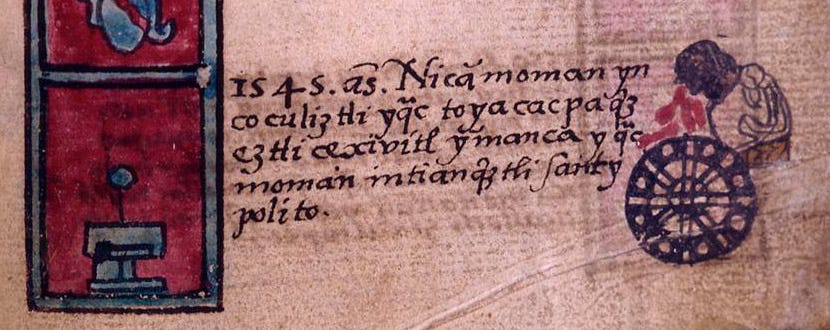
“1545. Here the plague [cocoliztli] extended. It was when blood came out from our noses. It lasted a year” (Dibble 1963:65).
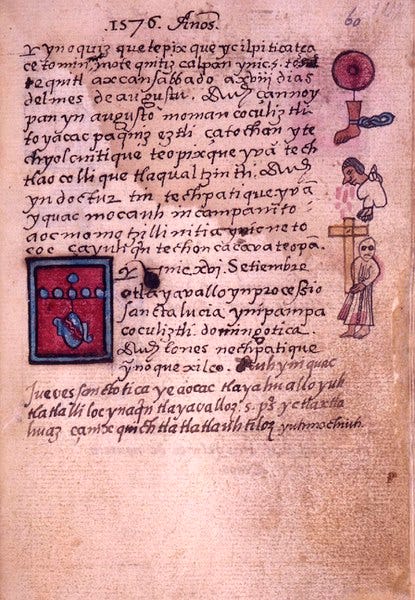
“1576. In August illness spread. Blood came from our noses. Priests confessed us in our homes and brought us food. Doctors healed us. And then the bells went quiet, they did not announce funerals anymore, as if we had abandoned the church” (Dibble 1963:85).
From Dumbarton Oaks: The years 1545 (left) and 1576 (right) are marked with images of Indigenous men naked and facing down, their eyes closed and copious blood flowing from their noses and mouths. These were symbols of the harrowing cocoliztli outbreaks that brought the Indigenous population to near extinction. In 1545, the blurred text reads, “epidemic or hemorrhage illness.” In 1576, the text reads, “with hemorrhagic illness came great mortality”; above 1576 and 1577 are two skulls (above right), symbols of widespread death. Below 1578, a Spanish figure dressed in blue and wearing a hat (below right) indicates the arrival of Felipe de Valdés, a bureaucrat sent by the colonial regime to assess the extent of the mortality of the 1576 outbreak. According to Relación de Tepechpan, by 1580 Tepechpan only had 950 tribute-paying residents, a dismal fraction of the once-populous and thriving town.
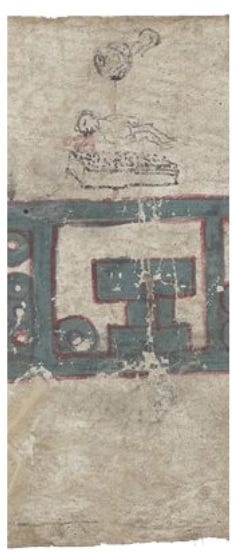
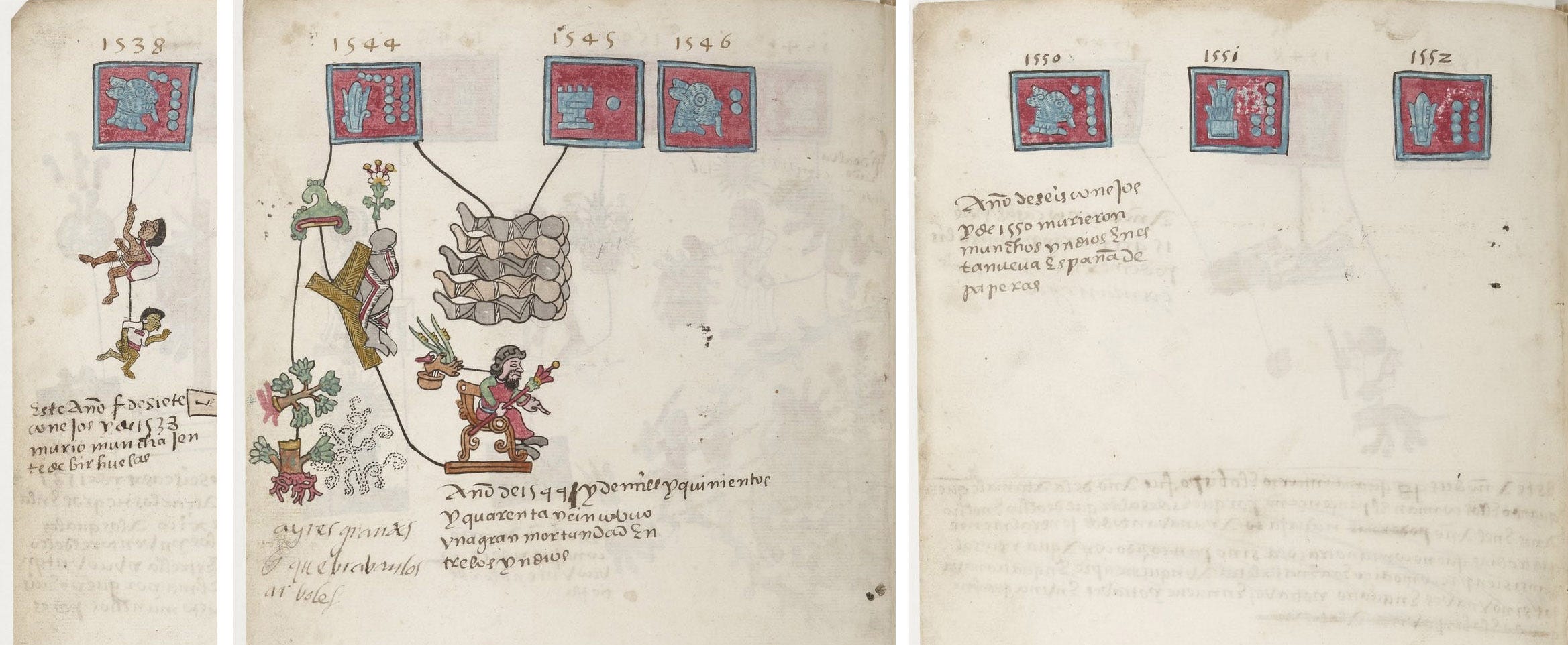
From Dumbarton Oaks: The harrowing cocoliztli outbreak of 1 House (1545) is represented in the Codex Mexicanus with a figure of a man lying down, bleeding from nose and mouth. The illness killed quickly, as victims experienced copious bleeding from all bodily orifices and high fevers. Despite being the most destructive of all outbreaks in the century, it is one of the least documented, probably because the devastation was so vast that few survivors were willing or able to record it. Lasting until 1548, the outbreak killed upward of fifteen million people, reducing the already wrecked Indigenous population by nearly 80 percent.
From Dumbarton Oaks: The most disastrous of all epidemic outbreaks to affect Central Mexico was the huey cocoliztli (great pestilence) of 1545, depicted in the middle image with a pile of bodies connected by lines to the years 13 Flint (1544) and 1 House (1545). The text reads, “Year of 1544 and one thousand five hundred and forty-five there was great mortality among the Natives.” Killing between five and fifteen million people, the outbreak diminished the Indigenous population by approximately 80 percent in less than three years. The highly lethal illness quickly spread across the region. It devastated Michoacán in six months, while in Jalisco it remained for three years. In Guatemala, a settler reported that “God sent down such sickness upon the Natives that three out of every four of them perished . . . because of this, all is now lost in Mexico, and here also” (Cook 1998:103–4). The calamitous 1545–1548 cocoliztli outbreak was followed by an outbreak of mumps in 1550. High fevers, neck swelling, and high mortality led to further ruin. One-third of male survivors suffered sterility, exacerbating the already staggering demographic collapse. The Codex Telleriano-Remensis’s authors registered the outbreak with a brief note in Spanish that reads, “this year of Six Rabbit and of 1550 many Natives died in this New Spain of mumps” (right image). The page lacks the rich glyphic illustrations of previous folios, and the years 7 Reed (1551) and 8 Flint (1552) are left empty, without records of any event. The decline in artistic production signals the increasing difficulty that the artists faced amid epidemic outbreaks and social collapse.
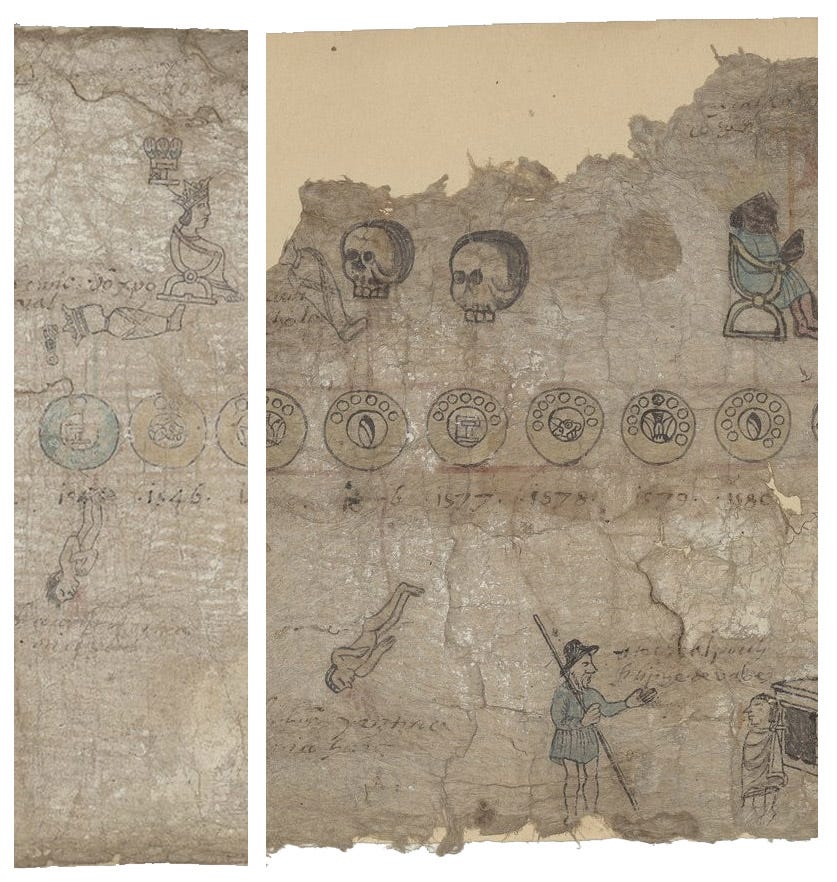
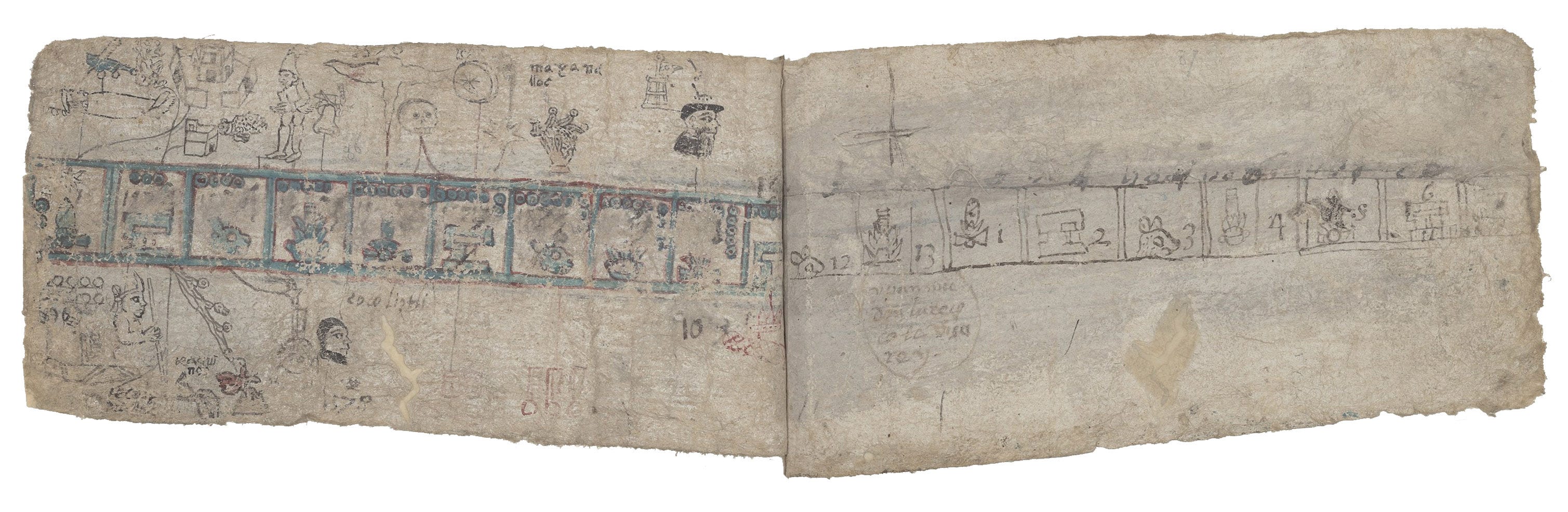
From Dumbarton Oaks: The unending water crisis fueled one of the worst epidemics of the century, the great cocoliztli outbreak of 1576, represented here by a skull hovering above 6 Flint (1576) and 7 House (1577). Above 8 Rabbit (1578) appears a glyphic compound of a hand and water, and above it the word mayanalloc, “there was hunger.” The compound crises of epidemics, famines, and water shortages led to exceptionally high mortality. The Indigenous population, already greatly diminished by decades of epidemics and colonial abuse, fell to levels of near extinction. The archbishop of Mexico estimated that more than half of the Indigenous population had perished between 1576 and 1583. That was the last year the Codex Mexicanus artists recorded completely. The next page (right) presents bare sketches for the years 1584–1590, their emptiness signaling a calendar left incomplete amid precipitous social decline.
Paris, Bibliothèque nationale de France, MS Mexicain 13–14 (Tira de Tepechpan), ca. 1596, fols. 17r and 19r. Courtesy of gallica.bnf.fr / BnF, via Dumbarton Oaks.
Paris, Bibliothèque nationale de France, MS Mexicain 23–24 (Codex Mexicanus), ca. 1590, fol.81. Courtesy of gallica.bnf.fr / BnF, via Dumbarton Oaks.
Paris, Bibliothèque nationale de France, MS Mexicain 23–24 (Codex Mexicanus), ca. 1590, fols. 86 and 87. Courtesy of gallica.bnf.fr / BnF, via Dumbarton Oaks.
Paris, Bibliothèque nationale de France, MS Mexicain 385 (Codex Telleriano-Remensis), ca. 1563, fols. 45v, 46v, and 47v. Courtesy of gallica.bnf.fr / BnF, via Dumbarton Oaks.
Codex en Cruz, via Amoxcalli.org.mx.
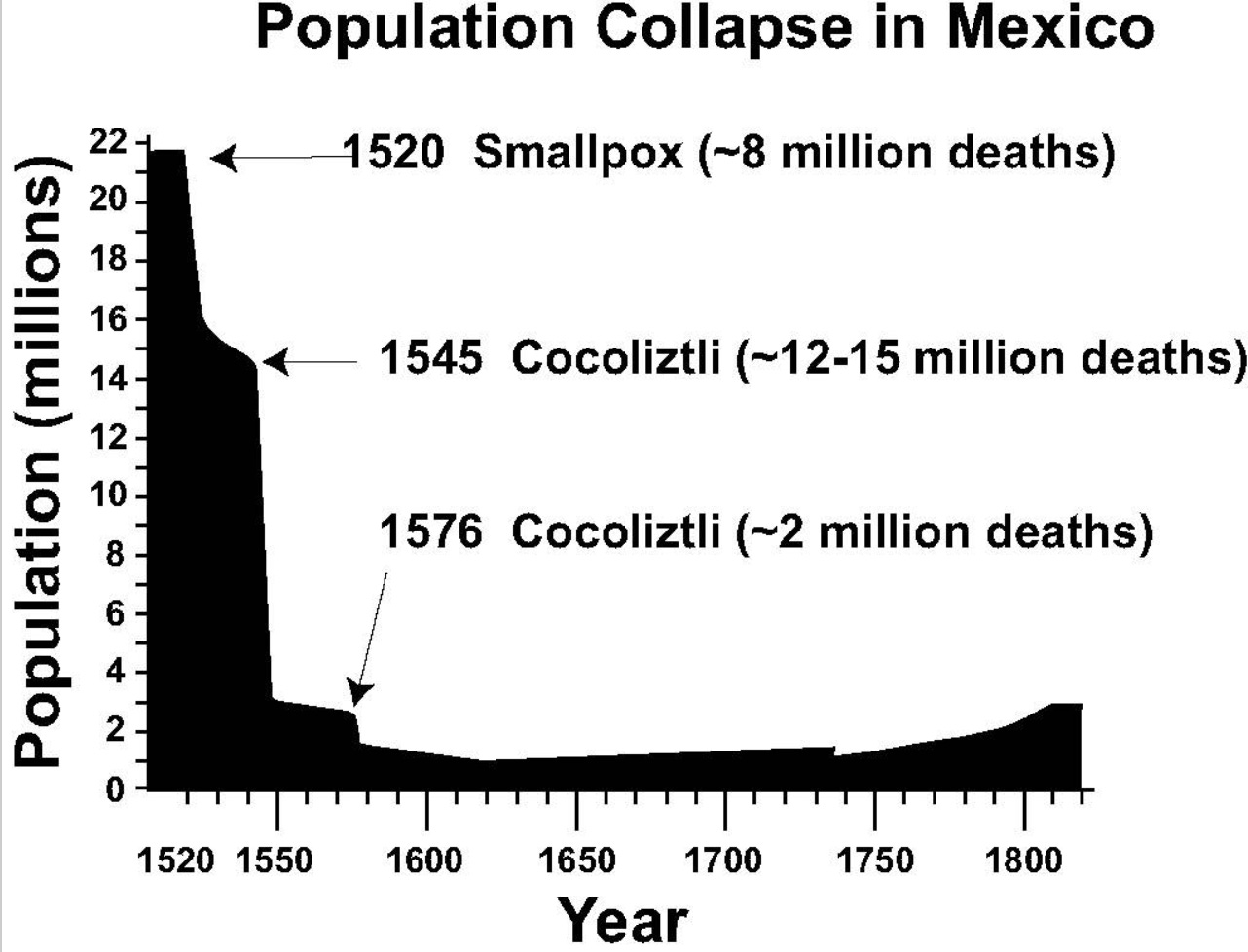
Acuna-Soto R, Stahle DW, Cleaveland MK, Therrell MD. Megadrought and megadeath in 16th century Mexico. Emerg Infect Dis. 2002 Apr;8(4):360-2. doi: 10.3201/eid0804.010175. PMID: 11971767; PMCID: PMC2730237.
In the Shade of Saturn is a reader-supported publication. To receive new posts and support my work, consider becoming a free or paid subscriber.
Hello Narcisse, I always look forward to reading your poetry. I find it deeply satisfying on several levels. Your sense of rhythm is perfect and this is a relief I cannot begin to articulate. My dissatisfaction with some formal poetry is not usually in a poet's difficulty with rhyme but with rhythm. I have an inherent need for it to be perfect. I haven't ever seen a single line by you which wasn't impeccable. Brooklyn as well. Also, your thematic material is so often delightful!


Hello Narcisse, I always look forward to reading your poetry. I find it deeply satisfying on several levels. Your sense of rhythm is perfect and this is a relief I cannot begin to articulate. My dissatisfaction with some formal poetry is not usually in a poet's difficulty with rhyme but with rhythm. I have an inherent need for it to be perfect. I haven't ever seen a single line by you which wasn't impeccable. Brooklyn as well. Also, your thematic material is so often delightful!
Yeah, this is next level..